

Aston Villa have now gone three Premier League matches without scoring, but the underlying numbers suggest Unai Emery’s attacking problem changed significantly during the 0-0 draw at Hull City.
Villa barely created anything during defeats to Brighton and Arsenal. Against Hull, however, they generated 1.75 expected goals, 13 shots and three big chances without finding the net.
That creates an important distinction.
The opening two games pointed towards a systemic chance-creation problem.
Hull looked much more like a finishing problem.
Aston Villa xG jumps dramatically at Hull
The scale of the improvement is striking.
According to StatMuse’s Aston Villa xG data, Emery’s side generated only 0.65 xG across their first two Premier League fixtures combined.
That was split between roughly 0.31 xG at Brighton and 0.34 xG against Arsenal.
Those numbers matched what supporters saw.
Villa had six shots and no shots on target during the 4-0 defeat at Brighton, with Sky Sports recording only 0.29 xG.
The Arsenal performance was more competitive but hardly more dangerous. Another seven attempts produced only around a third of an expected goal, with Villa again failing to test the goalkeeper. (footballwebpages.co.uk)
Hull was different.
StatMuse’s match data from the MKM Stadium gives Villa 1.75 xG from 13 attempts, alongside three big chances missed and 73 per cent possession.
Villa therefore created almost three times as much xG at Hull as they had across their opening two matches combined.
They still scored zero.
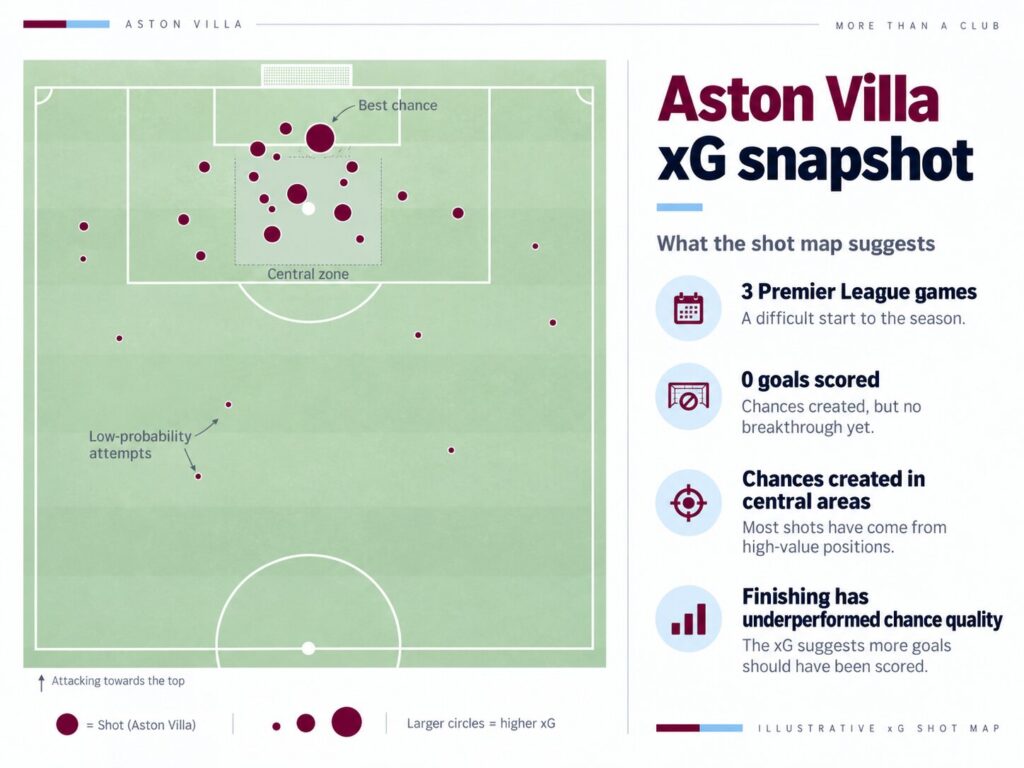
The goal drought is no longer only about chance creation
That is why the nature of Villa’s problem matters.
Against Brighton and Arsenal, blaming poor finishing would have missed the point. Villa were simply not generating enough quality opportunities.
Our pre-match analysis warned that Villa risked making unwanted top-flight history because of their attacking drought.
At Hull, the process improved.
Villa got into the opposition penalty area more consistently, created three big chances and accumulated enough xG to reasonably expect at least one goal.
The execution did not follow.
Emiliano Buendía wasted a major second-half opportunity after George Hemmings drove beyond his defender and cut the ball back.
Nicolas Jackson also failed to capitalise on an early Ian Maatsen delivery.
Villa continued to find promising positions without producing the finish required.
That is a very different concern from the sterile attacking performances of the opening fortnight.
George Hemmings provides one reason for improvement
Hemmings again justified Emery’s faith.
The 19-year-old provided Villa’s breakthrough shot on target and repeatedly offered a willingness to carry the ball towards Hull’s defence.
His emergence is particularly useful because he offers a different profile from several of Villa’s senior attackers.
The Read Aston Villa profile of George Hemmings details his progression from the academy into Emery’s first-team plans.
At Hull, his directness helped Villa turn possession into actual opportunities rather than simply circulating the ball around an organised defence.
That is something Emery will need to preserve.
What the xG says Unai Emery must fix
Through three Premier League matches, Villa’s problem cannot be reduced to one explanation.
The first two games were overwhelmingly about creation.
Villa produced only around 0.65 combined xG against Brighton and Arsenal. That is nowhere near enough attacking output for a team with Villa’s ambitions.
Hull represented progress.
A 1.75 xG performance should produce goals far more often than not, and three missed big chances make the 0-0 scoreline particularly frustrating.
The challenge now is turning one improved attacking performance into a trend.
Emery also has more options available than he did at the beginning of the season. Ibrahim Mbaye travelled to Hull after being included among the three summer additions expected to strengthen Villa’s options, although the £47million winger remained unused.
If the Hull chance creation continues and Jackson, Buendía, McGinn and Villa’s new attackers begin converting, the drought should eventually break.
If Villa return to the negligible xG levels seen against Brighton and Arsenal, the issue runs much deeper.
The Hull numbers therefore provide some encouragement.
They also make failing to score for a third consecutive league game even more difficult to excuse.








Comments.
Loading comments…