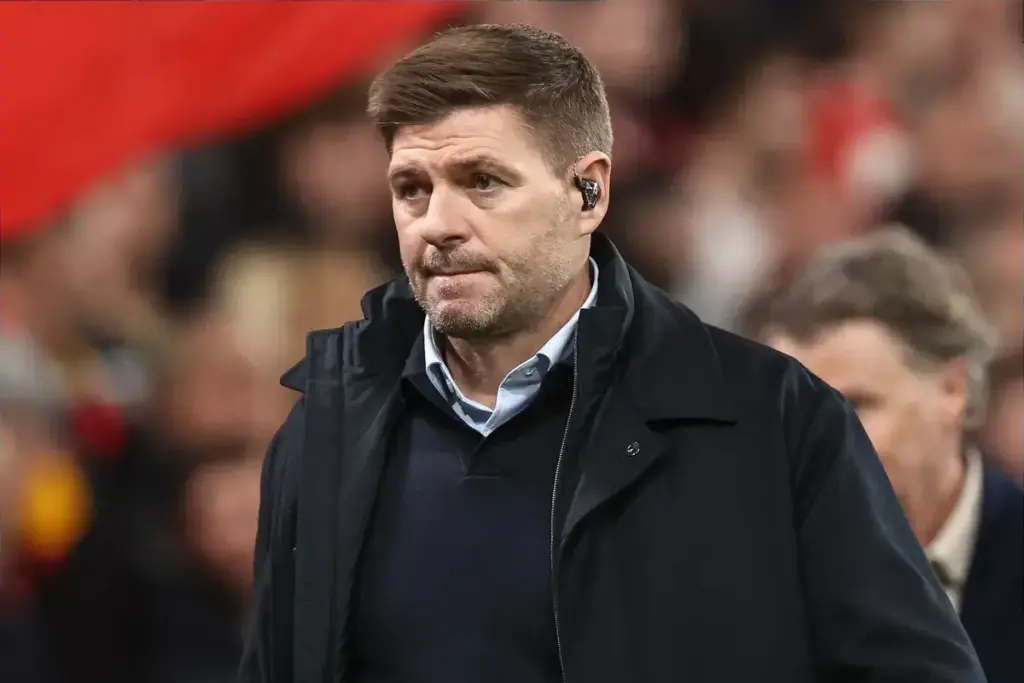

Ex-Aston Villa manager Steven Gerrard has revealed some honest truths about his time at Villa. After looking back at his sacking three-and-a-half years ago, he admitted that it was too early in his managerial career to take the Villa job.
For the Aston Villa faithful, the mention of Steven Gerrard’s tenure at B6 doesn’t just bring back memories of poor results it evokes the memory of a club that had fundamentally lost its way.
Now, three-and-a-half years after his departure, the 45-year-old has engaged in a period of serious soul-searching, finally admitting what the Holte End knew all along: he simply wasn’t ready.
In a candid reflection on The Overlap Podcast, the Liverpool legend conceded that his high-profile leap from the Scottish Premiership to the Premier League came “too early” in his managerial journey. It is a post-mortem that feels like the final chapter of a period that nearly derailed the Villa revolution.
A dream appointment turned nightmare
Gerrard was appointed in November 2021 following the dismissal of Dean Smith. While he initially appeared to stabilize the fort through the end of his first half-season, the 2022/23 campaign quickly spiraled into a tactical and emotional nightmare.
With just two wins from 11 matches, Gerrard was sacked in October 2022, leaving a club in total crisis.
The final nail in the coffin was a dismal 3-0 defeat to Fulham a night that left Villa hovering precariously above the relegation zone. Reflecting on the immediate aftermath of that dismissal, Gerrard didn’t shy away from the personal toll it took.
“I have had some difficult times. Obviously, when you get the sack, it is not nice. I had a period after Villa when my head was done in for months. I understood it. If you have a run of form like we did, the responsibility was mine, and I accepted it.”
Despite the collapse, Gerrard revealed he had been optimistic about his first full season in charge before the wheels came off.
“I was sitting around gutted because I felt like there was a big opportunity going into the first full season to build on a half-decent start. That was a tough one for me.”
The shadow of Ibrox and the regret of leaving
Before arriving at Villa Park, Gerrard’s reputation was sky-high. He had guided Rangers to their first league title since 2010/11, winning 124 out of 192 matches. However, looking back, he now views his departure from Glasgow as premature.
“The level was a big jump. Probably didn’t realise at the time when I made that decision. In hindsight again, we talk about hindsight, we’d all be great with hindsight, wouldn’t we? Would have stayed at Rangers longer, more experience, stay up there for longer. So I regret doing it now, sitting here, I didn’t at the time. It was tough.”
Gerrard also hinted at friction behind the scenes at Rangers following their title win, suggesting that the support required to sustain success wasn’t forthcoming.
“Also, the conversations with Rangers after we won it, the recruitment and the finance chats that we were having, didn’t feel like Rangers were ready to go again. It was a bit more of a like, ‘oh, let’s settle this and fix that and do that.’ The promises weren’t as strong as I thought they would be. Then the Premier League offer and opportunity comes in, it’s tough. It’s tough to say no to that.”
Despite the messy end to his time in the Midlands, Gerrard remained respectful of the institution.
“I’ve got nothing bad to say about Villa. I need to get that in as well. Villa are a really good club, good people, fantastic facilities. The opportunity was given to me, and it didn’t work out, so that’s on me.”
The “Emery effect” and the tactical divide
The lens through which we view Gerrard’s failure has been permanently sharpened by the historic success of his successor, Unai Emery.
It is perhaps the most damning indictment of Gerrard’s tenure that Emery took largely the same core group of players those who were supposedly “battling relegation” and transformed them into Champions League stalwarts within twenty-four months.
Where Gerrard saw a squad that needed “toning up” and a change in leadership symbolised by the controversial and divisive stripping of Tyrone Mings’ captaincy Emery saw untapped elite potential. While Gerrard struggled to find an attacking identity, the Spaniard implemented a world-class tactical blueprint that turned B6 into a fortress of European ambition
By the time of that final defeat at Craven Cottage, the atmosphere wasn’t just disappointed; it was toxic. There was a palpable, jagged disconnect between the dugout, the pitch, and the supporters. The “Hollywood” appointment that promised glamour had instead delivered a side that looked tactically adrift and emotionally drained.
A lesson in caliber
Gerrard’s admission that the leap came “too early” confirms a nagging suspicion among the fanbase: that Villa Park was treated as a training ground for a man eyeing the Liverpool job, rather than the destination it deserved to be.
Gerrard arrived with a legendary playing CV, but Emery arrived with a legendary managerial one. As Unai Emery prepares his side for another night under the European lights, Steven Gerrard’s road to redemption continues elsewhere.







Comments.
Loading comments…