Villa Park proudly stands as Aston Villa’s historic home. Indeed, it remains one of English football’s most iconic stadiums. Furthermore, the club has used this Birmingham fortress since 1897. Today, the ground continually evolves for modern football.
Specifically, Aston Villa recently rebuilt the North Stand. As a result, this project modernized facilities and improved matchdays. Consequently, the club pushed capacity past 50,000 for UEFA Euro 2028.
Ultimately, this guide covers everything you need to know. Therefore, lifelong fans and first-time visitors can easily explore stadium details here.
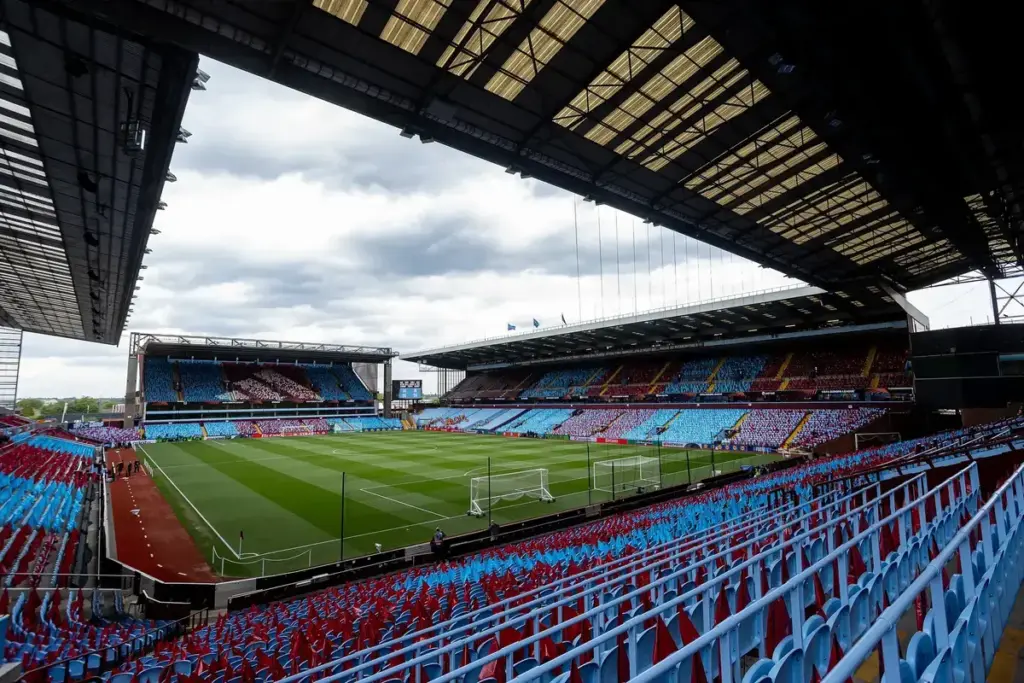
What is the capacity of Villa Park?
Villa Park’s capacity often fluctuates. Historically, the club adjusted seating for safety rules and structural upgrades. Previously, the ground comfortably held over 40,000 supporters.
However, Aston Villa launched a massive North Stand redevelopment in 2026. Thus, they solidified the stadium’s premier European venue status. During construction, the ground operated at a reduced 37,000 capacity. Naturally, closing the entire North Stand caused this temporary drop.

Eventually, builders integrated over 5,500 new seats. Consequently, Villa Park now welcomes more than 50,000 supporters.
Villa Park Capacity Timeline
| Era / Phase | Approximate Capacity |
| Pre-North Stand Redevelopment | 40,000+ |
| During Major Construction | ~37,000 |
| Modern Era | 50,000+ |
The Stands at Villa Park
Villa Park features four distinct stands. Crucially, each side boasts its own unique character and history.
The Holte End
The Holte End sits proudly behind the southern goal. Undoubtedly, it acts as the stadium’s beating heart. Moreover, passionate supporters gather here. As a result, they generate an intimidating atmosphere for visiting teams. Home to the Holte Enders, Brigada 1874 and 1897 Groups.
Trinity Road Stand
Meanwhile, the Trinity Road Stand lines the western pitch. Historically, it serves as a primary stadium structure. Additionally, the club houses main hospitality areas and premium seating here.
Doug Ellis Stand
Opposite Trinity Road, fans find the Doug Ellis Stand. Specifically, it spans the eastern touchline. Traditionally, Aston Villa places visiting away supporters in this section. View our Villa Park away fans guide here.
North Stand
Finally, the North Stand sits behind the northern goal. Presently, it represents the most modernized section. Furthermore, a massive project completely transformed this area. Consequently, it now features elite facilities and state-of-the-art concourses.
A Rich History: How Old is Villa Park?
Aston Villa first moved to Villa Park in April 1897. Initially, locals called it the Aston Lower Grounds.
Today, it remains one of England’s oldest active grounds. Remarkably, it boasts incredible sporting heritage. For instance, the stadium hosted historic World Cup and European matches. Additionally, it holds the record for FA Cup semi-finals. Overall, the ground beautifully balances historic charm with world-class facilities.
Where is Villa Park Located?
Villa Park sits in the Aston area. Specifically, you will find it just north of Birmingham city centre.
| Entity / Category | Official Details |
| Football Club | Aston Villa FC |
| Stadium Name | Villa Park |
| Street Address | Trinity Road |
| City | Birmingham |
| County | West Midlands |
| Postcode | B6 6HE |
| Country | United Kingdom |
Getting to Villa Park: Transport & Parking
What is the nearest train station?
Fans easily access the stadium via public transport. Therefore, the club strongly recommends trains on matchdays. Mainly, two railway stations serve the ground:
- First, Witton Station sits just a five-minute walk away.
- Second, Aston Station requires a 15-minute walk.
Conveniently, both stations offer direct connections to Birmingham New Street.
Can you drive to the stadium?
Drivers can reach Villa Park by road. However, the club strongly discourages direct matchday driving.
Instead, local councils enforce strict traffic restrictions and exclusion zones. Additionally, resident-only parking schemes operate nearby. Moreover, the club limits stadium parking to authorized personnel. Therefore, traveling fans should use official park-and-ride services. Alternatively, they can park safely in city-center car parks.
Why Villa Park is the Soul of Aston Villa
Villa Park represents much more than a venue. Essentially, it stands as a physical monument to club legacy. Furthermore, it bridges the gap between Victorian history and modern ambition. Throughout every expansion, the stadium retained its architectural charm. Ultimately, it remains a true cathedral of English football.
Trophies Won at Villa Park
| Competition | Titles Won | Most Recent Win |
|---|---|---|
| First Division / Premier League | 7 | 1980–81 |
| FA Cup | 7 | 1956–57 |
| League Cup | 5 | 1995–96 |
| European Cup / Champions League | 1 | 1981–82 |
| UEFA Europa League | 1 | 2025–26 |