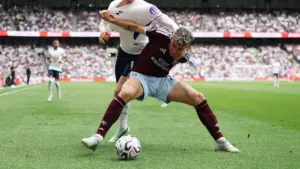

Andoni Iraola’s first public message on Harvey Elliott carried encouragement for Liverpool and an uncomfortable reminder for Aston Villa.
Liverpool’s new manager confirmed that Elliott will receive a proper chance during pre-season after returning from a deeply unsatisfactory season at Villa Park. Iraola described the midfielder as eager, motivated and determined to prove himself again.
Those comments create a straightforward Liverpool story. A talented player has returned from a difficult loan and now has an opportunity under a new coach.
From Villa’s perspective, the episode should prompt a much harder review. Elliott arrived as an established Premier League player and England Under-21 standout, yet his loan became dominated by a purchase clause rather than his football.
Villa allowed the contract to shape selection
Villa signed Elliott on deadline day last September through an initial season-long loan. The club’s official announcement confirmed an obligation to buy linked to appearances, but it did not disclose the exact trigger or fee.
Reports later stated that a 10th Premier League appearance would have committed Villa to a £35m permanent transfer. Elliott never reached that number, and he finished the campaign with limited involvement across all competitions.
The financial logic behind Villa’s decision was understandable. Elliott did not establish himself strongly enough to justify a major permanent outlay, while the club had to manage tight financial and squad-cost restrictions.
However, the agreement created a situation in which selecting the player carried a direct financial consequence. Once Villa decided against buying him, the loan lost much of its sporting purpose.
ReadAstonVilla previously examined how the Elliott deal collapsed and where responsibility sat between Villa and Liverpool. The central problem remains the structure both clubs accepted.
Villa wanted access to a talented player without guaranteeing a long-term commitment. Liverpool wanted an obligation strong enough to secure a substantial sale. Elliott then carried the cost when the sporting and financial decisions moved in different directions.
Iraola’s comments sharpen the criticism
Iraola said Elliott had returned early, trained with Liverpool’s Under-21s and shown a clear hunger to rebuild his position at Anfield. He also called the Villa situation “strange” and noted that the club could not put him on the pitch.
The full Liverpool press conference presented Elliott as part of Iraola’s immediate pre-season plans. The manager intends to assess him rather than treat last season as proof that he cannot contribute.
That approach reflects poorly on the outcome at Villa. Elliott did not suddenly lose the technical quality that once made him a regular Liverpool squad member. He simply joined a team where his contractual trigger soon became more important than his development.
Unai Emery admitted during the season that the arrangement was hurting the player. Once Villa reached that point, they had already lost control of the situation.
The club could not justify another league appearance if it had rejected the permanent deal. At the same time, keeping Elliott away from meaningful football served neither his career nor Villa’s squad.
The loan also failed Villa on the pitch
The damage did not apply only to Elliott. Villa also spent a season carrying a player they could not use freely.
Emery needed creative depth across midfield and the attacking positions, particularly during a demanding European campaign. Elliott should have offered control between the lines, energy without the ball and cover for several roles.
Instead, Villa effectively reduced their own options because the agreement made each league appearance financially significant. The squad place remained occupied, but the manager could not treat Elliott like an ordinary loan player.
That outcome highlights a recruitment issue rather than just an unfortunate clause. Villa must ensure future temporary deals support Emery’s sporting plans throughout the season, even when a permanent transfer becomes unlikely.
A purchase obligation can provide clarity when both clubs genuinely expect the move to become permanent. A low appearance trigger creates the opposite effect when the buying club remains uncertain about the player’s long-term value.
Villa need a cleaner approach this summer
Elliott now returns to Liverpool with a fresh opportunity, while Villa enter another summer needing creative and midfield depth. The club saved the £35m permanent fee, but it received very little value from the loan itself.
ReadAstonVilla has already looked at the need for a smoother summer after last year’s restricted and reactive transfer business. The Elliott episode should sit near the top of that review.
Villa should not avoid loans or conditional transfers altogether. They remain useful tools, especially under financial pressure, but the conditions must leave the manager free to select players on merit.
Elliott’s Liverpool chance does not prove that Villa should have bought him for £35m. His limited impact never justified that commitment.
It does show that Villa entered an agreement which eventually stopped working for the player, the manager and the club. Iraola can now offer Elliott the clean start that Villa’s deal never allowed.